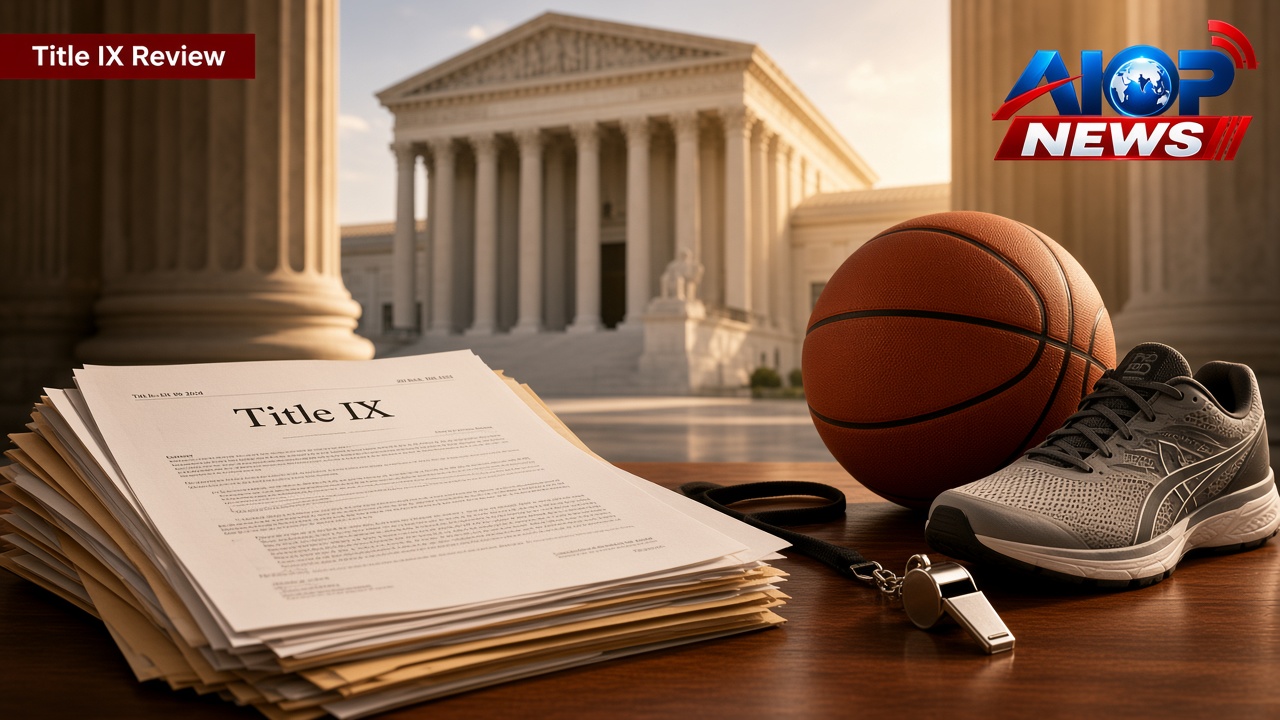
Donald Trump has asserted that Title IX protections exclude transgender girls, bringing renewed national attention to the federal statute governing sex-based discrimination in schools. The statement arrives at a pivotal moment for schools across the country, as legal observers anticipate that the U.S. Supreme Court could weigh in next on how federal education law applies to transgender students.
The interpretation represents what analysts describe as the flip side of a recent U.S. Supreme Court decision that upheld state laws barring transgender girls. As debates over school participation and civil rights persist across the education sector, school districts and state officials are closely monitoring whether the nation's highest court will step in once again to clarify the reach of federal protections.
The Conflict Over Title IX and Federal Civil Rights
Title IX has long served as the cornerstone of federal policy protecting students from discrimination on the basis of sex in federally funded educational programs and activities. However, the exact scope of the statute has become one of the most contested questions in modern education policy.
Trump’s declaration that Title IX excludes transgender girls stands in direct opposition to arguments that the federal statute protects students on the basis of gender identity. By asserting that the law does not encompass trans girls, Trump has reinforced an interpretation centered on traditional definitions of sex. This posture has intensified national debate over how federal civil rights statutes should be applied within primary and secondary schools as well as higher education institutions.
For school administrators, differing views on federal law create complex compliance challenges. When federal interpretations clash with evolving legal standards, education leaders are frequently left navigating conflicting directives regarding athletic participation, facility access, and overall student rights.
The Judicial Landscape: A Recent Supreme Court Precedent
The prospect of the Supreme Court examining Title IX comes shortly after the high court issued a ruling upholding state laws that bar transgender girls. That decision validated state-level statutory frameworks designed to restrict participation in school settings.
Legal analysts emphasize that Trump's current assertion regarding Title IX presents the reverse side of that very issue. While the recent Supreme Court decision affirmed that states have the authority to enact laws barring transgender girls, the question of whether Title IX itself explicitly excludes them under federal law remains an unresolved matter for the high court.
Key Differences Facing School Districts
The ongoing legal friction places public institutions in an intricate position:
- State-Level Measures: Following the Supreme Court's ruling upholding state bans, several states have maintained or enacted prohibitions impacting transgender girls.
- Federal Statutory Mandates: Uncertainty persists over whether Title IX permits, prohibits, or requires the exclusion of transgender girls from specific educational programs.
Could the Supreme Court Weigh In Next?
Because federal courts nationwide continue to grapple with challenges related to sex discrimination in schools, the U.S. Supreme Court could soon be petitioned to address Title IX directly. Observers suggest that the justices may need to provide a definitive ruling to resolve differences between state legislative actions and federal statutory standards.
If the high court takes up the issue, the resulting decision would establish a national precedent. A definitive Supreme Court ruling on whether Title IX excludes transgender girls would establish uniform standards across all fifty states, reshaping administrative guidelines for public school boards, university administrators, and athletic associations.
Concluding Summary
Trump’s assertion that Title IX excludes transgender girls brings the debate over federal civil rights back to the forefront of educational policy. Operating as the flip side of a recent Supreme Court ruling that upheld state laws barring transgender girls, the development highlights deep divisions over how federal education statutes should be interpreted. With legal questions still lingering across school systems nationwide, the U.S. Supreme Court could weigh in next to deliver a final verdict on the reach of Title IX.
For additional details on this ongoing policy debate, read the full reporting from Education Week.