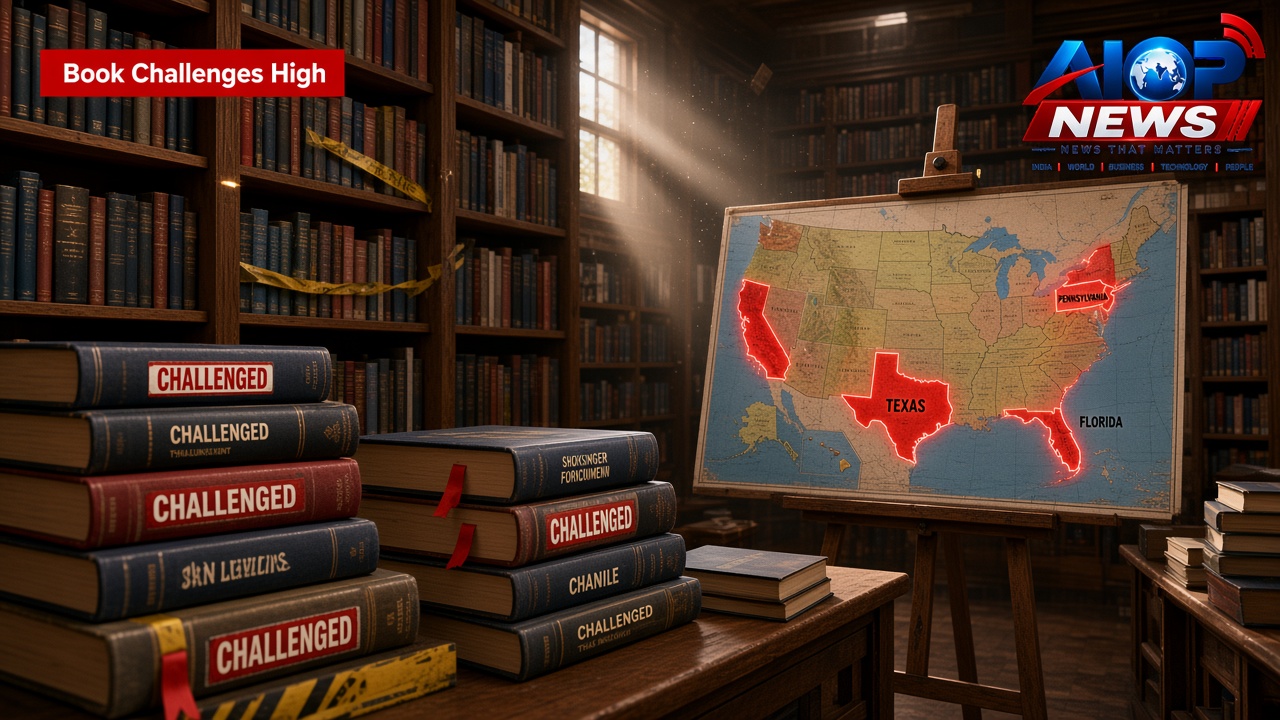
Efforts to challenge and remove books from school libraries across the United States remain near all-time highs, according to newly released data. While the national discussion around public school reading materials continues, fresh findings indicate that these challenge efforts are far from evenly distributed across the country. Instead, the vast majority of attempts to restrict access to library books are heavily concentrated within a handful of states.
This persistent trend highlights an ongoing focus on school media collections, localized administrative policies, and student access to literature. As public school systems navigate guidelines regarding library materials, educators and administrators face ongoing inquiries regarding book availability.
Geographic Concentration of Library Book Challenges
The latest data shows that while the national volume of formal book challenges continues to hover near historic peaks, the geographic distribution of these efforts is strikingly uneven. Rather than reflecting a uniform nationwide increase in formal complaints, the activity is disproportionately centered in a small number of states.
In these specific regions, formal requests to audit, restrict, or remove books from school media centers have seen significant activity. Conversely, school districts in many other parts of the country report far fewer formal challenges. This sharp contrast suggests that state-level policy environments and organized community campaigns play a pivotal role in driving formal review requests within public school districts.
Implications for K-12 Education and School Governance
The continued elevated rate of book challenges carries broad implications for education policy, district governance, and daily school operations. Administrators, school librarians, and local education boards are frequently required to establish formal committees and allocate time to review challenged titles in accordance with district policies.
For school leaders operating in states with high concentrations of challenge activity, managing these review processes demands significant administrative focus. Educational leaders must consistently evaluate library collections against local policies, curriculum goals, and legal standards. When books are temporarily restricted or permanently removed during a review, it directly affects the range of titles accessible to students in school libraries.
State Policies and Source Insights
A recent report by Education Week underscores how closely state-level environments correlate with the volume of library complaints. Where legislative frameworks or state guidelines simplify or encourage challenge mechanisms, local school boards tend to receive a higher volume of formal removal requests.
Because the surge in challenge activity remains limited to specific geographic areas, local school leaders across different states face vastly different operational realities. While some districts handle frequent formal reviews, others maintain standard library management protocols with minimal external challenge activity.
Conclusion
The latest findings demonstrate that while book challenges in public schools remain near record high levels, the movement is largely defined by intense concentration in a small number of states. As educational institutions continue to refine media policies, school boards and administrators remain focused on managing library standards, upholding district policies, and supporting student learning in a complex educational landscape.